
Determinants of demand for fruit and vegetables

Measuring the effects of price and weather on household purchases

Determinants of demand for fruit and vegetables
Summary A A
LinkedIn's logo Twitter's logo Facebook's logo

Among the factors determining demand for fruit and vegetables, price and weather play an important role in household purchases. A study based on data covering the period 2017-2022 measured the effect of these two variables on purchases of around twenty different fruit and vegetables.

Published 16/09/2025

Decline in quantities purchased since 2020

In recent years, household demand for fresh fruit and vegetables has been characterised by a non-linear trend in purchases [1]. Between 2018 and 2020, volumes purchased, and associated expenditure increased significantly. The year 2020 is marked by a peak in purchases due to the shift of out-of-home consumption to purchases for home consumption - restaurant closures, lockdowns and homeworking. Since then, both volumes purchased and expenditure have decreased: quantities purchased by households in 2023 are well below the five-year average, although expenditure remains above average, due to the rise in the average purchase price in a context of food inflation, particularly in 2023 (Figure 1).
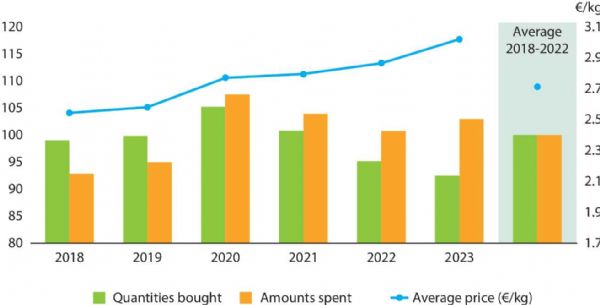
Figure 1: Development of fresh fruit and vegetable purchases

Despite this downward trend in volume purchases, fruit and vegetables as a whole enjoy a very high market penetration rate of 99.9%. This reflects the fact that virtually everyone buys fruit and vegetables at least once a year. However, the share of households buying fruit and vegetables differs significantly from one species to another. Some, such as tomatoes, apples and carrots, have a high penetration rate of over 85%. These products are heavyweights in the household shopping basket. Not only are they purchased by a large number of households, but they are also consumed in large quantities: 13 kg/household/year for tomatoes, 14 kg for apples and 9 kg for carrots. Conversely, other products are positioned in niche markets with fairly specific profiles, such as asparagus, with a 30% penetration rate and a very senior consumer profile (Figure 2).

Figure 2: Penetration rate of fruit and vegetables (average 2020-2022)

Seasonal demand

Among the various agricultural products, fresh fruit and vegetables are characterised by a certain seasonality in demand that echoes production cycles. Despite the extension of marketing periods thanks to new production and storage techniques or the arrival of imported products, the seasonality of purchases remains strong (Figure 3). This seasonality is more pronounced for certain species. Summer fruit is generally consumed over a relatively short period, from a few weeks for cherries to a few months for melons. Other species are consumed all year round, such as apples, oranges, tomatoes and carrots, although the scale of their purchases can fluctuate according to the season.

Figure 3: Seasonal demand for fruit and vegetables

Seasonal demand cycles can also be disrupted by the weather, which can stimulate or discourage demand, regardless of supply. A very hot summer, for example, will tend to increase purchases of refreshing products such as melons, watermelons and cucumbers. Conversely, cooler, rainy summer weather will turn consumers away from these products, as was the case in the summer of 2021, which was marked by unseasonably cool weather.

Prices also follow a seasonal cycle

Over the period 2018-2022, the average purchase price for fresh fruit and vegetables was €2.64/kg. Depending on the species, this average price varies widely: from €1.44/kg for carrots to €7.20/kg for strawberries or asparagus (Figure 4). These differences are mainly due to production and harvesting costs - particularly labour costs - as well as packaging, storage and distribution costs. These costs may differ from one species to another, depending on their characteristics.

Figure 4: Average purchase price of fruit and vegetables, 2018-2022

The prices of fruit and vegetables vary throughout the year depending on supply and demand, forming a U-shaped curve. At the start of the season, low volumes on the market lead to high prices, reflecting a scarcity effect. The middle of the season is characterised by abundant volumes and lower prices, except in the case of extreme weather conditions. At the end of the season, when supply falls, prices rise again [2]. However, this pattern can vary from one year to the next, depending on supply and demand. In 2021, for example, this was the case for apricots, where a historically low harvest due to a period of spring frost led to a rise in average prices (Figure 5).

Figure 5: Comparison of the change in price and quantities purchased between 2017 and 2022 of apricot

Price and weather significantly impact purchases ...

For most fruit and vegetables, consumer studies conducted in recent years by the CTIFL show that price is one of the top three purchasing criteria for consumers, along with product appearance (freshness, firmness) and origin (Figure 6). Some studies also highlight the influence that the weather has on demand. Experiments conducted in the CTIFL1 experimental sales area have shown that rising temperatures at the end of summer, around late August and early September, were associated with higher purchases of end-of-season products such as melons and peaches/nectarines. In addition, econometric studies carried out on purchase data for certain types of fruit and vegetables between 2009 and 2014 have made it possible to measure the varying importance of the weather in fruit and vegetable sales [3].

Figure 6: Selection criteria given by consumers (in ordre of importance)

This econometric study, covering the period 2017-2022 (see box Methodology used in this econometric study), measured the effect of price and weather on the quantities purchased by households for around 20 species (Figure 7). The results show that purchasing decisions for fruit and vegetables respond to variations in price and temperature for almost all of the species studied. In other words, household purchases are significantly correlated with these two variables. Price variations have a negative impact on the quantities purchased: quantities decrease when the price increases and vice versa. Temperature variations have a positive or negative impact depending on the species. Among the products studied, only onions are not correlated with the weather conditions, probably because their consumption is roughly the same regardless of the season.

Figure 7: Species studied - each species is associated with the season when purchases are highest.

... with varying intensity depending on the species

While price and weather influence household purchases, the response of demand to changes in price and temperature varies depending on the species studied. The intensity of this response was measured using elasticity calculations (see box on Price elasticity). Figure 8 allows us to distinguish between several types of products according to their degree of sensitivity to price variations (price elasticity on the horizontal axis) and temperature variations (weather sensitivity on the vertical axis).

Figure 8: Price elasticity and weather sensitivity of demand for fruit and vegetables

Weather sensitivity

In the literature, for "fruit and vegetables" as a whole, the reference values for price elasticities of demand are generally between -0.5 and -1 [4] [5] [6]. A first result highlighted by the CTIFL study is the disparity of price elasticities at species level, which vary from -0.5 for carrots to -2.3 for grapes and apricots.

Summer fruit (Group 1) is characterised by demand that is influenced by price variations, except for melons. Their elasticity is well above 1 in absolute terms. For apricots and cherries, the average purchase price is higher than for the average fruit and vegetable, which may explain why consumers find it easier to give up these products when the price rises. Conversely, a fall in price leads to a proportionally greater increase in purchases. Summer fruit is also characterised by a high degree of weather sensitivity. A rise in temperatures significantly boosts purchases of melon, peach-nectarine and apricot. This can be explained by the refreshing quality of these products in hot weather. Conversely, unseasonably low temperatures lead to low demand.

A second group of products, including vegetables such as tomatoes, courgettes, peppers, aubergines and even cucumbers, are characterised by a positive impact of the weather on their purchases, but only to a limited extent. These products are less weather-sensitive than summer fruit. In fact, even though these vegetables are often associated with summer, the fact that they are marketed throughout the rest of the year means that their consumption is less sensitive to variations in temperature. These products also have a price elasticity of between -0.6 and -1, which puts them in the average range for fruit and vegetables, with the exception of tomatoes, which have a price of elasticity of -1.2, which no doubt includes the effects of range2.

Finally, when temperatures fall, a third group of products sees an increase in purchases: these are the characteristic winter products, with apples, kiwis and oranges for fruit, and carrots, leeks, Belgian endive and cauliflower for vegetables. However, the variation in purchases is less than that in temperatures, with elasticities of between -0.5 and -0.2. Price elasticities, meanwhile, are fairly scattered: products such as carrots have a demand that reacts little to price variations, while others such as Belgian endive, cauliflower and apples have a demand that is more elastic to price variations. For these products, the segmentation of supply and effects of range may partly explain these higher values.

In addition, econometric tests have shown the variability of price elasticities throughout the marketing season: they appear higher at the beginning and end of the season, and lower, or even close to 0, at the height of the season. These results are in line with those highlighted in a previous study specifically on summer fruit3 and with other works in the literature [7]. This can be explained by the lower average price at the height of the season due to the increase in supply, and by the more essential nature of the products at this time of year, which makes their demand less influenced by price. It also means that price changes, particularly downward ones, have a greater impact at the start of the season.

In conclusion

Following on from previous work on fruit and vegetable purchasing mechanisms, this econometric study measured the effects of price and weather on household purchasing behaviour, using data series covering the period 2017-2022.

The findings on price elasticities of demand can inform public policy on measures to support fruit and vegetable consumption, one of the objectives of the French Fruit and Vegetable Sovereignty Plan. They can also support companies' pricing policies by highlighting the differences in purchasing behaviour in response to price variations depending on the species. The results also show that a price change, particularly a downward one, does not have the same impact on the quantities purchased depending on the period considered. The impact is greater at the start of the season and, conversely, more limited at the height of the consumption season.

Similarly, the study underlines that while the weather has a significant impact on purchases of most fruit and vegetables, the intensity of this impact differs according to the species. Weather sensitivity plays a key role when temperatures rise, with summer fruit appearing to be the most weather-sensitive products. While purchases of winter products increase when temperatures fall, their weather sensitivity is less marked. However, this result should perhaps be qualified by the fact that (very) hot summers have been more frequent than harsh winters in recent years. Furthermore, as our analysis is based on weekly data, we still need to examine whether this weather sensitivity balances out between different periods, in order to determine the overall effect (volume/value) over the season as a whole.

In terms of implications, there is the question of how these results can be used by players in the sector. To what extent can weather forecasts support operators' flow and stock management? In the event of favourable weather, distributors could increase supplies of weather-sensitive products, depending on available supply. Conversely, in the event of bad weather, they could reduce and/or diversify their supplies with substitute products, thereby reducing the potential for losses in shops. In this case, it also raises the question of alternatives for upstream players to manage the reduction in demand (what storage capacity, what other outlets, etc.).

Methodology used in this econometric study

The results presented in this article come from a study carried out for Interfel's Economic Commission, the aim of which was to analyse the determinants of demand for fruit and vegetables by measuring the effects of price, promotion and weather on household purchases.

To do this, the CTIFL has carried out an econometric study using different data sources: Kantar data for household purchases (quantities bought and amounts spent), Météo France temperature indices, A3 Distrib data for promotional activity. The econometric tests are based on weekly data covering the period 2017-2022. This article presents the results for the impact of price and weather. Detailed results and methodology can be found in the full study report: https://www.ctifl.fr/rapports-d-etude (in French).

The concept of price elasticity

Price elasticity is a concept widely used in the field of public policy, particularly food policy, to assess the effects of a tax or subsidy on household demand. It is also a tool widely used by companies to support their pricing policies. It involves measuring the effect of a price change on the change in quantities purchased by households, in other words measuring the sensitivity (or responsiveness) of demand to a price change. It illustrates the market's level of flexibility in relation to price variations for goods or services. The price elasticity of demand is generally negative, reflecting an inverse relationship between changes in prices and quantities demanded: when the price of a product rises, its demand falls, and vice versa. When the coefficient of elasticity is greater than 1 (in absolute terms), we speak of a strong elasticity: the quantities demanded vary more than proportionally to the variation in prices. Conversely, when the elasticity coefficient is less than 1, the elasticity is low: quantities demanded vary less than proportionally to price variations.

1 In particular, as part of the 'Seasonal Competition' project (Projet Concurrence saisonnière) (2021-2024) which analyses consumer perceptions and expectations during seasonal transition periods (winter-spring and summer-autumn). Forthcoming publications.

2 The price elasticity of demand for round tomatoes, of which the average purchase price is 2.30 €/kg compared with 3.14 €/kg for tomatoes as a whole, is lower in absolute terms (-0.92) than the price elasticity of demand for tomatoes (-1.2).

3 Price elasticity of demand: purchasing mechanisms for products with high seasonal consumption. Presentation to the Interfel Economics Committee, 16 December 2020.

Les données clés à retenir

Les déterminants de la demande de fruits et légumes - Mesure des effets prix et météo sur les achats des ménages

Les variations de prix et les fluctuations de température influencent généralement les achats des ménages bien que ces comportements varient selon les espèces et les saisons. Les fruits d'été, comme le melon et la pêche-nectarine, sont très sensibles à la météo. En été, une hausse de température de 2 à 3 °C (environ 10 %) peut entraîner une augmentation des achats de melon de près de 25 %. Les variations de prix affectent plus fortement la demande pour les produits très saisonniers et plus coûteux, tels que l'abricot, le raisin, l'asperge et la cerise. L'intensité de réaction des achats aux variations de prix varie au cours de l'année : elle est plus prononcée en début et en fin de saison et plus modérée en pleine saison. Autrement dit, les consommateurs semblent moins influencés par le prix en pleine saison.

Key points

Determinants of demand for fruit and vegetables - Measuring the effects of price and weather on household purchases

Price and weather fluctuations generally influence household purchasing behaviour, although this varies according to species and season. Summer fruit, such as melons and peaches/nectarines, are very sensitive to the weather. In summer, a rise in temperature of 2 to 3°C (around 10%) can lead to an increase in melon purchases of almost 25%. The variations in price more intensely affect demand for highly seasonal and more expensive products, such as apricots, grapes, asparagus and cherries. The intensity of the reaction of purchases to price variations varies over the course of the year: it is more pronounced at the beginning and end of the season, and more moderate at the height of the season. In other words, consumers seem to be less influenced by price at the height of the season.