
Introduction
In recent years, tree fruit growing has often been criticised by the media and society. The two main issues highlighted are the high number of plant protection treatments and their application by spraying. Tree-fruit production is still heavily dependent on plant protection products, with an average treatment frequency index of 10, rising to 36 for dessert apples. Controlling the quantities of plant protection products applied is therefore a major issue for this sector.
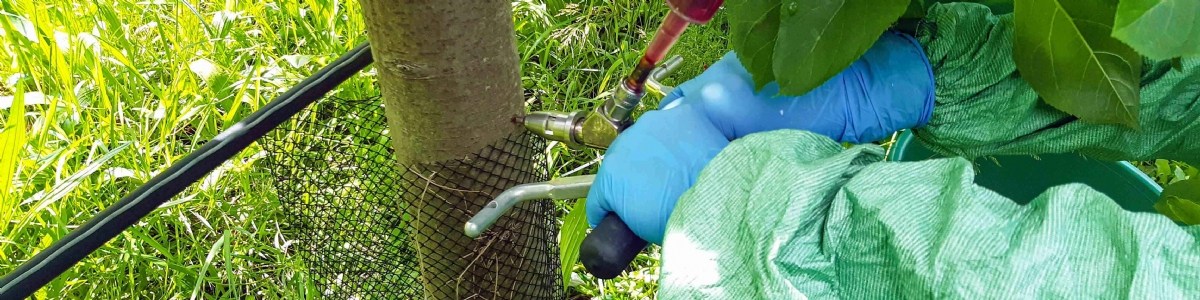
In French climatic conditions, these crops face great pressure from numerous diseases and pests every year, which have a significant economic impact on production. The application of synthetic or biocontrol products by spraying the trees, when carried out with axial fan airblast sprayers, has major disadvantages: product drift in the air and water, noise generated by the fan, and the availability of high-performance equipment and operators at the right time. Under certain conditions, the use of a sprayer can also lead to application failures, particularly on large trees, on certain target pests and pathogens such as vascular system pathogens, as well as with certain biocontrol products. The answer to these problems may lie in adapting the control strategy and reorganising how the orchard is protected. This is the focus of the work carried out since 2015 and, more recently, as part of the MISPA project (Micro-Injection Sécurisée pour la Protection des Arbres - Secure micro-injection for tree protection).