
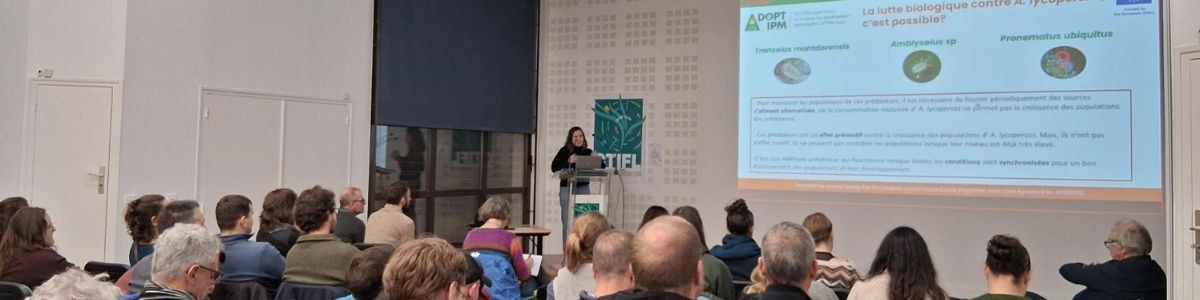
This technical meeting was organised as part of the European ADOPT-IPM project (www.adopt-ipm.eu) and was the result of a collaborative effort between CTIFL, INRAE and ACTA. It brought together several project partners from the Mediterranean region: IRTA in Spain, the University of Catania in Italy, CTIFL (Balandran centre) and INRAE (Avignon centre) in France. ACTA, which is partly responsible for disseminating the project results, was also present.
This event brought together advisors, distributors, producers and other stakeholders of the fruit and vegetable sector around a common goal: to identify levers for managing pests in order to develop effective and sustainable integrated pest management strategies. It provided an opportunity to present the project results obtained in several European countries on very important regional issues (management of aphids, Nesidiocoris tenuis bugs, tomato russet mite and powdery mildew). The aim of this meeting was also to discuss the results presented with the participants and to share feedback.
Proposing additional management levers to address technical deadlocks
The technical meeting was introduced by Benjamin Gard, head of the integrated protection programme in protected crops, at the Balandran centre. He reiterated the importance of sharing applied research findings across the Mediterranean basin and comparing them with feedback from professionals.
Benjamin Gard (CTIFL) presented the results of a trial on aphid management in lettuce crops. In spring, the presence of flower strips enabled the early and massive establishment of natural enemies, ensuring control of lettuce aphids similar to that obtained with the chemical reference. The flower strips, planted one month before the crop, already hosted large populations of beneficial insects, promoting their rapid spread throughout the crop. On the other hand, the release of lacewing eggs proved to be of little benefit, with very few individuals found after application. In autumn, the later arrival of natural enemies resulted in insufficient control of aphids.
Antonio Biondi and Antonio Gugliozzo (UNICT) presented the results on the use of trap plants for the control of the bug Nesidiocoris tenuis. The combination of companion plants such as sesame and verbena significantly limits the damage caused by Nesidiocoris tenuis on tomatoes while promoting its early establishment. In plots where tomatoes are associated with trap plants, the number of necrotic rings on tomato plants is significantly reduced compared to crops grown without companion plants, indicating better control of this insect's phytophagous behaviour. In the Italian context, Nesidiocoris is considered a beneficial insect for tomato cultivation, and sesame and verbena have proven effective in ensuring rapid and uniform establishment on the crop.
Paula Molina (IRTA) detailed the results of a multi-year trial on the management of the tomato russet mite. Several species of predatory mites have made it possible to achieve a level of control of tomato russet mite in tomatoes in greenhouses that is comparable to the reference strategies used by producers (sulphur + acaricides). In three trials conducted between 2024 and 2025, releases of Transeius montdorensis and Amblyseius sp. showed notable efficacy against Aculops lycopersici, paving the way for credible alternatives to acaricide treatments. With regard to Pronematus ubiquitus, research must continue to identify the factors that favour the establishment of this predator.
Marc Bardin (INRAE) presented the results of research conducted on the use of natural substances (biofungicides) to control powdery mildew in tomatoes. Both the ADOPT-IPM and conventional strategies provided satisfactory control of powdery mildew in both cases, and growth and yield levels were comparable in cultivation. While the conventional strategy effectively controlled the disease with a single fungicide treatment, the ADOPT-IPM approach also limited its development. However, limitations were observed in pest management: mite populations increased significantly in the ADOPT-IPM strategy, while they were controlled in the conventional approach thanks to two specific acaricide treatments. These results highlight the need to adapt the ADOPT-IPM strategy to strengthen mite control.
Philippe Delval (ACTA) opened this technical meeting by presenting the objectives and main areas of research of the ADOPT-IPM project, which focuses on innovation and optimisation of integrated protection strategies in protected and open field crops. He then went on to detail the system for evaluating the packages (IPM levers combination) tested within the demonstration trial network. Following the technical presentations, Philippe led a participatory session with the audience to elicit their reactions to the solutions presented and their potential adoption by professionals. The morning concluded with a look at the project's prospects for 2026 and the tools that will be made available: a dedicated online tool for developing protection strategies, the Pest Management Portal, supplemented by a toolbox containing all the project's communication and transfer materials.
CTIFL would like to warmly thank ACTA, INRAE, IRTA and the University of Catania for their highly qualitative contributions, as well as all the participants for their contribution to the success of this meeting.
The project has received funding from the European Union's Horizon Europe programme under grant agreement No 101060430.